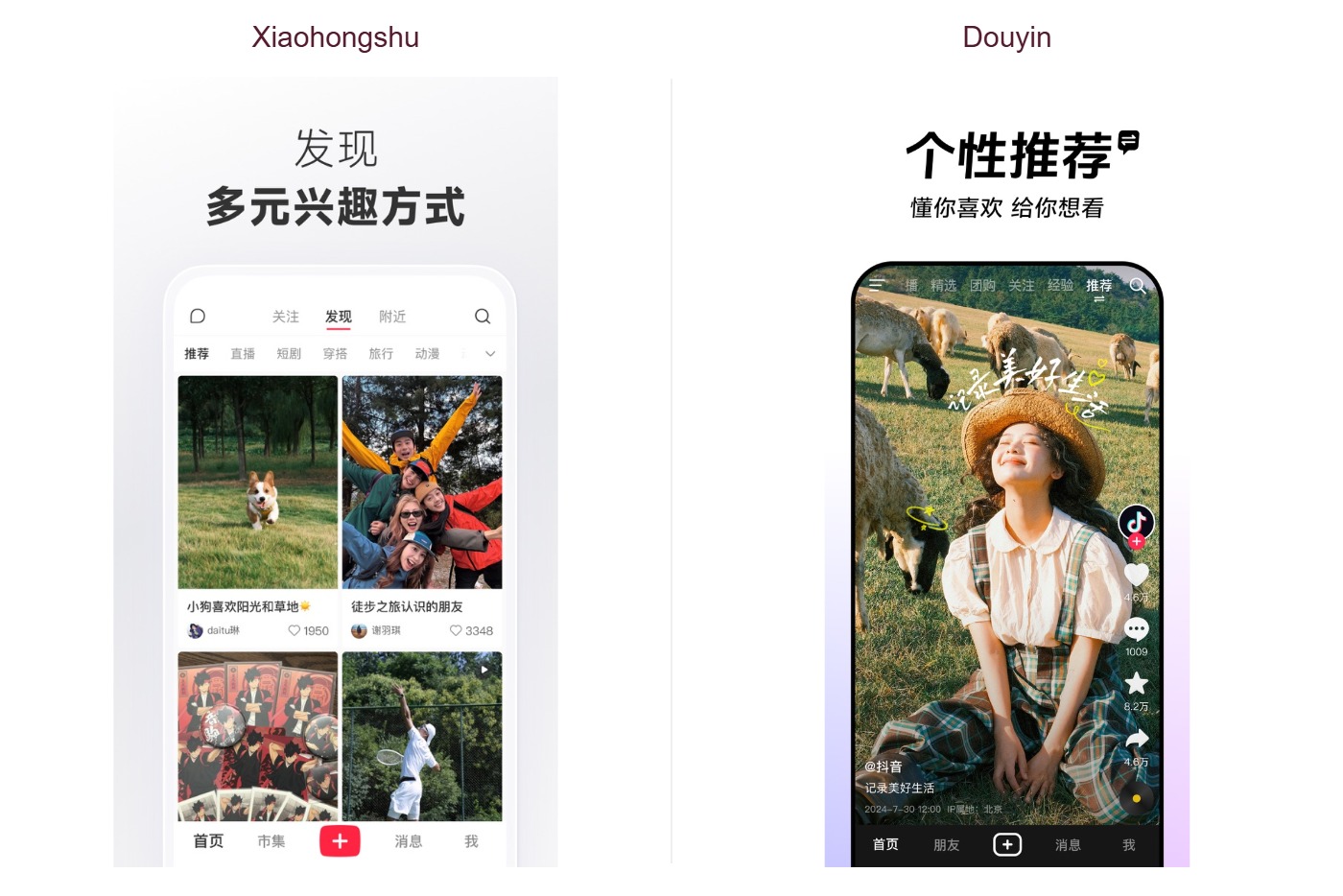
Xiaohongshu and mainland Douyin both combine content discovery, search, social interaction and commercial activity. Their differences become clearer when you look at the experience each presents, the audiences it reaches and the reasons people choose to spend time there.
Xiaohongshu describes itself as a community built around life and interests. Its content can help someone explore a hobby, compare a product or understand another person's experience. Douyin offers a broad mix of video, livestreams, entertainment, knowledge and everyday life, alongside search and commercial services.[1][2]
For Hong Kong readers, understanding both is useful before considering a marketing programme. The comparison below covers features, audience profiles, culture, subjects and usage time. It also explains where the two platforms overlap, because the same person can use each for several different purposes.
Understanding the Two Platforms
Douyin Is Distinct from International TikTok
This article concerns Douyin, the mainland Chinese platform. International TikTok audience figures should not be substituted for Douyin data: the products, markets and measured populations differ.
Xiaohongshu is also referred to as RED or RedNote in English-language discussion. We use Xiaohongshu throughout to keep the comparison consistent.
The features someone sees may vary by app version, account and region. A broad platform comparison explains the available types of experience; it does not establish which commercial tools a particular Hong Kong business can access.
Both Extend Beyond Shopping
Xiaohongshu's publisher description includes interests, personal stories, interaction, product discovery and offline activities. Douyin's description includes livestreams, short dramas, creative effects, longer videos, knowledge and cultural content.[1][2]
Douyin Local Life, which includes relevant venue and group-buying services, is one part of the wider platform. Similarly, Xiaohongshu marketing is a business activity within a community that people also visit for enjoyment, information and connection. Starting with this wider picture avoids overlooking much of what users encounter.
Platform Features at a Glance
Content Formats and Discovery
Xiaohongshu can present an experience through image-led posts, writing and video. Douyin is strongly associated with moving images, but its formats also include image-and-text content and longer viewing experiences. The following comparison describes capabilities and presentation, rather than exclusive uses.[1][2][3]
| Feature | Xiaohongshu | Mainland Douyin |
|---|---|---|
| Content forms | Image-and-text posts, video and accounts documenting interests or experiences. | Short video, image-and-text content, longer video, short dramas and livestreams. |
| Discovery | A discovery grid presents several covers to choose from, alongside followed accounts and interests. | A recommendation feed gives one video the main screen, alongside followed content, live viewing and other formats. |
| Search | Finding subjects, experiences, products and practical information. | Active keyword search, with documented support for video and image-and-text results. |
| Interaction | Comments, likes, saves and exchanges around shared interests. | Comments, likes, sharing, live interaction and participatory creation. |
| Creation | Stories, guides, demonstrations, personal records and interest-based contributions. | Video storytelling, effects, performances, demonstrations and responses to shared topics. |
| Commercial activity | Product discovery, shopping and relevant brand or creator activity. | Product and venue discovery, commerce and services including Douyin Local Life. |
The publishers' interface examples also show different browsing rhythms. Xiaohongshu's discovery view presents several covers and titles together, allowing someone to compare subjects before opening a post. Douyin's recommendation view gives the main screen to one video, letting movement, sound and a story unfold.[1][2] For a creator, the first experience calls attention to the clarity of the cover and title; the second brings the opening, pacing and visual explanation into focus. These are practical considerations arising from the displayed interfaces, whose presentation can vary by entry point and version.
Search and Participation Matter on Both
It is useful to distinguish browsing from arriving with a question, without assigning either behaviour to only one app. Someone can encounter a subject unexpectedly, search for more detail and then join a discussion.
Douyin's official search documentation explicitly covers keyword search and image-and-text search as well as video.[3] That is a practical reminder that its use extends beyond passively watching a stream of short clips.
Who Uses Each Platform?
A Comparable Mainland Audience Snapshot
QuestMobile's October 2025 app data provides a consistent reference for this comparison. Its report, published on 16 December 2025, shows Xiaohongshu with a younger, more female-skewing audience than the main Douyin app in that measured population.[4]
| Audience Measure, October 2025 | Xiaohongshu | Douyin Main App |
|---|---|---|
| Female users | 64.2% | 50.4% |
| Male users | 35.8% | 49.6% |
| Age 24 or younger | 34.8% | 23.0% |
| Age 25-30 | 19.4% | 14.1% |
| Age 31-35 | 17.9% | 11.3% |
| Age 36-40 | 10.0% | 9.4% |
| Age 41-45 | 5.7% | 8.9% |
| Age 46-50 | 7.0% | 11.2% |
| Age 51 or older | 5.3% | 22.2% |
Combining the first two age groups gives 54.2% aged 30 or younger on Xiaohongshu, compared with 37.1% on Douyin. These are calculations from the report's published bands. Rounding means the individual age shares need not sum to exactly 100%.
The same report places 37.2% of Xiaohongshu users and 29.4% of Douyin users in its combined first-tier and new first-tier city categories, again calculated from the two original groups.[4] These classifications describe location, not the income or spending power of an individual user.
Read the Pattern Without Turning It into a Rule
The figures help describe an audience mix. They do not mean that Xiaohongshu is only for young women, or that Douyin addresses a single age group. Both include men and women across the reported ages.
These are mainland app measurements from October 2025, not a Hong Kong survey or a September 2026 update. They are a useful starting point for understanding the platforms; the audience of a particular topic, creator or brand account can differ substantially.
How Content Culture Differs
Xiaohongshu: Experience, Detail and Shared Interests
In July 2025, Xiaohongshu changed its Chinese positioning from a life guide to a community for life and interests. Reporting on the change described both practical subjects, such as recipes and travel information, and expanding interest communities.[5]
One way to understand that culture is through detail: what an item looks like in use, how someone completed a task, or what they discovered while pursuing a hobby. A post can become a starting point for questions, additions and exchanges between people with similar interests.
The platform's stated community values include sincere sharing and friendly interaction.[8] These describe the culture it encourages, rather than guaranteeing the accuracy or tone of every individual post.
Douyin: Movement, Storytelling and Participation
Video allows a creator to convey a process, performance or moment through movement, sound and pacing. A cooking demonstration, a short drama and an explanation of a new technology can all use those qualities in different ways.
Douyin's 2025 annual hotspot report included tutorials, entertainment, sport and cultural subjects. It also described participation through recreated content, challenges and responses to shared topics.[7] These examples help explain a culture in which viewers can become contributors as a subject develops.
The Differences Are Tendencies, Not Boundaries
Xiaohongshu also contains entertainment, humour and video. Douyin also contains careful explanations, practical information and searchable answers. A detailed product comparison can be a video; a still image can prompt a lively conversation.
The most useful distinction is how a particular piece earns attention and what it enables the viewer to do next. Format and tone should follow that purpose, rather than a rigid assumption about everyone using an app.
Which Topics Attract Attention?
Recurring Subjects and Dated Trends
Food, travel, home, fashion, technology, sport and entertainment can support continuing streams of content. A specific film, new tool or sporting event may create a more concentrated period of discussion.
The examples below come from 2025 annual reporting and related coverage published in early 2026. They illustrate the range of interests; they are not a live list of September 2026's most popular topics.[6][7]
| Platform | Examples from 2025 Reporting | What the Examples Illustrate |
|---|---|---|
| Xiaohongshu | Fuse-bead crafts, journalling and crochet. | Making, showing a result and exchanging techniques with other enthusiasts. |
| Xiaohongshu | Birdwatching and climbing. | Outdoor interests, personal discoveries and practical experience. |
| Xiaohongshu | Anime-related collectibles and doll clothing. | Specialist interests that extend beyond conventional shopping advice. |
| Douyin | DeepSeek explainers, reviews and tutorials. | Technology can become a subject for accessible learning and demonstration. |
| Douyin | Creative responses to the film Ne Zha 2. | Entertainment can develop into commentary and participatory creation. |
| Douyin | The Jiangsu Football City League and China's National Games. | Sporting events can provide a shared subject for discussion and creation. |
Use the Examples as Context
The Xiaohongshu examples were discussed in coverage of its 2025 interest report published on 6 January 2026.[6] The Douyin examples come from its 2025 hotspot report, carried as promotional information on 20 January 2026.[7]
Neither set establishes a current ranking or the share of all content devoted to those subjects. Their value is in showing the variety of interests and ways of participating within each platform.
What People Come to Find
Enjoyment and Unexpected Discovery
A person may open an app without a purchase or question in mind. A story, performance, amusing observation or unfamiliar hobby can be worth their time in its own right.
For example, someone might enjoy watching a craft being made without planning to buy it. Understanding that possibility helps separate an engaging content experience from an immediate commercial intention.
Practical Answers and More Confident Choices
At another moment, the same person may need specifics: how a dish is prepared, whether a product fits a small room, or what to expect when visiting a place.
An illustrative Hong Kong dining journey could involve discovering a restaurant in a video, looking for menu details, comparing experiences and checking the location. Those steps could occur across either platform and other sources. There is no single compulsory route from discovery to decision.
People Who Share an Interest
Comments and contributions can help someone find others who recognise the same hobby, question or experience. Participation may mean asking for advice, adding a useful detail or making a response of their own.
Shopping and visiting a business can form part of these journeys, but so can learning, enjoyment and belonging. Content that recognises the immediate reason a person is there has a clearer purpose than material that assumes every viewer is ready to buy.
How Much Time Do Users Spend?
The October 2025 Monthly Figures
In the same QuestMobile report, Xiaohongshu recorded average monthly usage time per user of 1,430.9 minutes, equivalent to approximately 23.8 hours. The main Douyin app recorded 2,529.0 minutes per user for the month, approximately 42.2 hours.[4]
The figures therefore show greater monthly time per user for Douyin in that snapshot. They are monthly averages, not daily viewing time per daily active user. The hours are a rounded conversion of the published minutes.
Using one source and month makes the comparison more useful than combining unrelated figures found in separate articles. It also keeps international TikTok and other Douyin apps outside this specific comparison.
What More Time Does, and Does Not, Tell You
A longer average indicates more recorded time within the measured app. It does not explain every session or tell a brand whether its intended customers will welcome a particular message.
Someone might watch a long programme, follow a livestream, browse short clips or return repeatedly to look for information. These activities can produce different relationships with a product or brand.
For a business, time spent is context. The relevance of the audience, the content and the response remains a separate question. A useful answer read briefly can matter to a customer even when it contributes relatively little to an app's total time.
What This Means for Hong Kong Brands
Start with the Audience and the Moment
Consider who you want to reach and what they are doing when your content becomes relevant. A visitor exploring Hong Kong, a resident researching a product and an enthusiast following a specialist subject need different information.
Use broad demographics to frame that thinking, then examine the actual audience and subjects relevant to the brand. A platform-wide percentage cannot decide the right creator or content direction on its own.
Adapt the Presentation and Keep the Facts Consistent
The same verified product or venue information can support different stories, demonstrations and guides. Choose the format that makes the subject clear and respects the reader's purpose.
Our Xiaohongshu marketing introduction explores that work in more detail. Businesses considering an offer tied to a venue can also read the Douyin Local Life introduction and restaurant preparation guide.
Platform search, website search visibility and AI-generated recommendations need separate observations. Strong performance in one is not evidence that the others have produced the same result.
Frequently Asked Questions
Is Douyin the Same as TikTok?
Douyin is the mainland Chinese platform discussed here. International TikTok operates in different markets, so its audience figures should not be used as Douyin statistics. This article uses data for the main Douyin app.
Is Xiaohongshu Mainly for Young Women?
Its October 2025 audience in the cited report skewed younger and more female than Douyin's. However, 35.8% were male, and the reported ages extended well beyond 30. Topic-specific audiences need their own assessment.
Is Douyin Mainly for Young Viewers and Entertainment?
Its audience spans the reported age groups; in October 2025, 22.2% of the measured main-app audience was aged 51 or older. Entertainment is part of its scope, alongside knowledge, technology, practical demonstrations and cultural subjects. Age and content interests should be assessed separately.
Which Platform Is Better for Finding Useful Information?
Both can support active search and practical content. Use the subject, the specificity of the answer and the credibility of its source to judge usefulness. A platform label alone cannot establish whether an individual recommendation is accurate.
Does Douyin's Longer Usage Time Make It the Better Marketing Choice?
The reported time describes app use, not the likely return from an individual campaign. Audience relevance, the customer's purpose, content quality and available business arrangements all matter. The right choice depends on what the brand is trying to help someone understand or do.
Discuss Your Audience with FaceBid
FaceBid's mainland China marketing overview (Chinese) describes its work across Xiaohongshu, Douyin and mainland creator collaborations.[9]
To discuss a suitable approach, contact FaceBid on WhatsApp with a short introduction to your brand, the audience you want to reach and the products or experiences you want people to understand. Those details provide a practical starting point for considering the platform and content together.
Chat on WhatsAppSources
- Xiaohongshu, China App Store: publisher description of the platform and its experiences.
- Douyin, China App Store: publisher description of formats and features.
- Douyin Open Platform: Search Capabilities: official documentation updated 30 June 2025.
- QuestMobile report published 16 December 2025: October 2025 audience profiles and monthly time per user.
- Beijing Daily, 9 July 2025: reporting on Xiaohongshu's positioning and interest communities.
- CQNews, 6 January 2026: coverage, credited to Tide News, of Xiaohongshu's 2025 interest report.
- Douyin's 2025 hotspot report, 20 January 2026: platform-report material published as promotional information on China Daily's website.
- Jiefang Daily, 20 January 2026: reporting on Xiaohongshu's stated community values.
- FaceBid: Mainland China Marketing: company source for its publicly described service scope.